February 12, 2026
The Rise of Pre-Fabrication
Off-Site Precision: How Prefab Reduces Timelines in Large Commercial Mechanical Projects
Large commercial and industrial facilities face constant pressure to open faster, operate efficiently, and control project risk. Mechanical systems are often one of the most complex and schedule-sensitive parts of construction, and that’s exactly where prefabrication is changing the game.
What Prefabrication Means in Commercial Mechanical Construction
In commercial mechanical construction, prefabrication typically includes building major system components off-site, such as:
Multi-trade corridor racks
Pump skids and equipment assemblies
Piping spools and valve packages
Mechanical room modules
Hydronic and process piping assemblies
Medical gas or specialty system assemblies
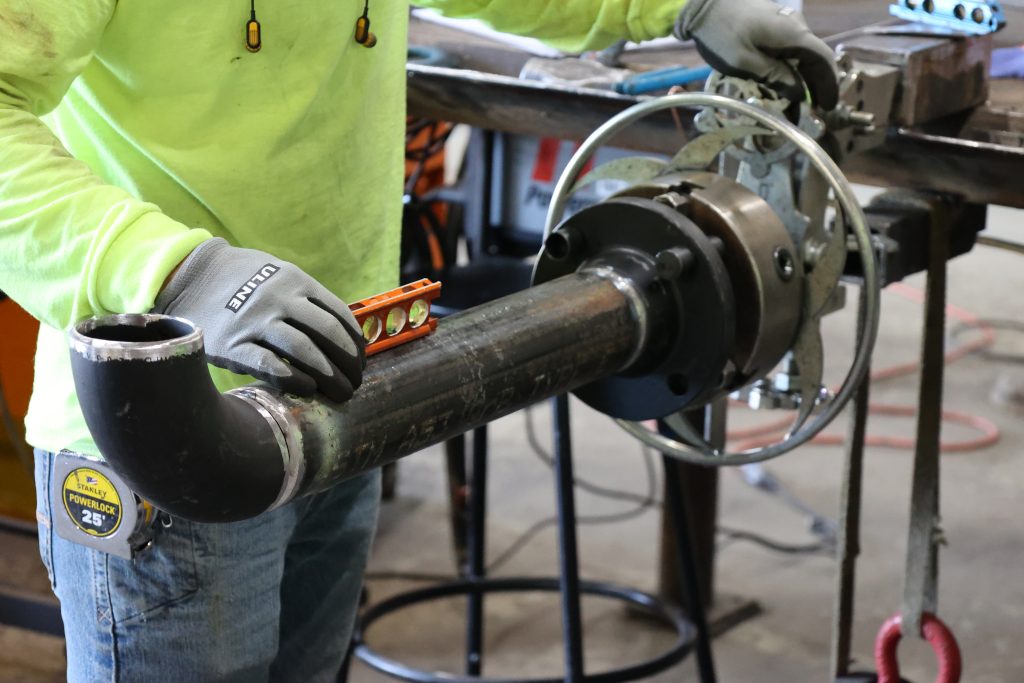
These assemblies arrive on-site ready for installation, reducing field labor hours and compressing
overall project schedules.
The Biggest Advantage: Parallel Construction
Traditional mechanical installation is tied directly to building progress. Prefabrication changes that model.
Instead of waiting for full building readiness, teams can:
• Fabricate piping and mechanical assemblies off-site
• Complete structural and building enclosure work on-site
• Deliver finished systems for rapid installation
Many prefab-enabled projects see overall construction timelines reduced, depending on system complexity and project coordination.
For owners and facility operators, this often means earlier occupancy, faster commissioning, and a quicker path to revenue.
Reduced Schedule Risk for Large Facilities

Weather Exposure
Factory-built assemblies aren’t affected by weather delays, keeping production schedules stable even during seasonal construction slowdowns.

Trade Congestion
Moving labor hours off-site reduces overcrowding in ceilings, corridors, and mechanical spaces, lowering the risk of installation conflicts and rework.

Material Flow Disruptions
Fabrication environments allow for more controlled material planning and staging, improving supply chain reliability.
Quality and Performance Advantages
Mechanical systems demand precision. Small installation inconsistencies can create long-term performance issues.
Controlled fabrication environments support:
- Consistent weld quality and joint integrity
- Standardized testing and quality checks
- Improved system cleanliness for sensitive environments
In facilities such as healthcare, life sciences, and advanced manufacturing, this level of quality control is critical to system reliability and compliance.
Labor Efficiency Without Sacrificing Craftsmanship
Prefabrication is not about replacing skilled labor — it’s about using skilled labor more effectively.
Fabrication shops allow teams to work in safer, more efficient environments with better tools, better ergonomics, and repeatable processes. That often results in:
- Higher productivity per labor hour
- Improved safety outcomes
- Reduced rework and field corrections
- More consistent installation results
Cost Predictability and Project Control
While every project is unique, prefabrication often improves financial predictability by reducing unknowns.
Key drivers include:
- Less material waste
- Fewer schedule-driven overtime costs
- Reduced rework and change orders
- Shorter overall construction durations
For owners, faster completion can also reduce financing costs and accelerate operational startup timelines.
Where Prefabrication Is Making the Biggest Impact
Off-site mechanical fabrication is especially valuable in:
- Healthcare facilities
- Data centers
- Advanced manufacturing
- Higher education campuses
- Large commercial developments
- Mission-critical facilities
These projects benefit most from schedule certainty, system reliability, and installation precision.
The Future
Prefabrication is quickly becoming standard practice in large-scale mechanical construction. As BIM coordination, digital fabrication, and automation continue advancing, more system components will move off-site.
The shift is moving construction toward a manufacturing-style delivery model — one built on planning, precision, and repeatable quality.